
January 18, 2026
Osaka Church
In the Name of the Father, and of the Son, and of the Holy Spirit.
We often live with the thought, “I am myself, and others are others.”
This does not mean that people are selfish egoists who never care about anyone else. Rather, many of us quietly assume that no matter how close we may be—even as spouses or family—there is a deep gap between one person and another that can never truly be crossed. We believe that complete understanding is impossible, that we cannot truly share our lives at the deepest level.
And so we resign ourselves to the idea that, in the end, every person is pushed back into their own loneliness.
From there, we convince ourselves that the only honest way to live is to avoid hurting one another as much as possible, to skillfully sidestep conflicts of interest or emotion, to keep the social rules we have created, to fulfill our duties and responsibilities, and to endure the pain of loneliness with dignity.
But… is that really the truth?
In one sense, yes. Our own hearts and bodies, worn out by the strain of human relationships, know that this is indeed a fact of life.
It may be a fact, but it is not the truth.
For when we face the sorrow of not being able to share ourselves with others, when we stand alone before our own loneliness, something rises up from deep within us—a cry that says:
“This loneliness cannot be the real truth! No, this is not how it should be!”
That cry itself is the proof. Human beings cannot endure what is not true.
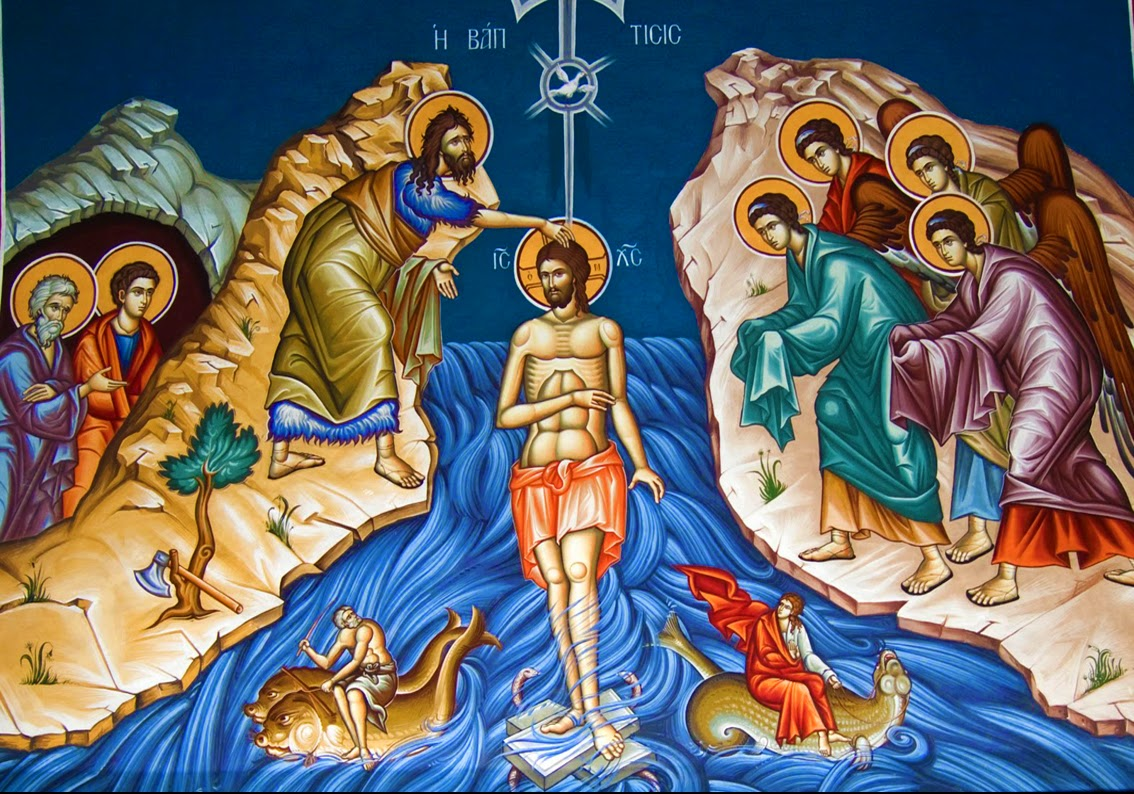
When Christ received baptism from John in the Jordan, the voice of the Father resounded from heaven: “This is my beloved Son.” And the Holy Spirit descended upon Christ, the Son, in the form of a dove. Before the eyes of the people, the Father, the Son, and the Holy Spirit were revealed.
Here, God showed us His own love—offered to us who struggle in the reality of human loneliness. The Father, the Son, and the Holy Spirit are each completely free, and yet perfectly united, sharing all things with one another. This communion of the Holy Trinity was shown to us.
This is God’s answer to our cry: “Such loneliness cannot be the truth.”
Scripture teaches that human beings were created in the image and likeness of God. If we believe this, then the communion revealed on the banks of the Jordan is the very form in which we ourselves were created to live.
- There is no forced obedience born of power, violence, or fear.
- There is no superficial unity held together by pressure.
- Nor is it a fragile peace maintained only by rules that balance competing interests.
Instead, people are completely free, compelled by nothing, and yet they willingly share everything. Love alone binds person to person, and nothing exists between them except love. Human beings were meant to live this love.
When the Church teaches that since Adam and Eve turned away from God we have damaged the divine image within us, it means that we have lost this likeness to the Trinity—this unity of love, this sharing of our deepest selves.
But God did not reveal His Triune self at the Jordan simply to show us what we lost and make us despair. On the contrary, through Christ standing in the waters, God promised that we would be restored to that image again—that humanity would be saved.
The Church is the place of that restoration.
The Divine Liturgy shows us that this restoration is not an illusion. When we gather, worship with one heart and one voice, and joyfully share one bread and one cup, the joy of humanity and the radiance of God’s love overflow in our midst.