
February 8, 2026 ・ Luke 15:11–32
Osaka Church
In the name of the Father, and of the Son, and of the Holy Spirit.
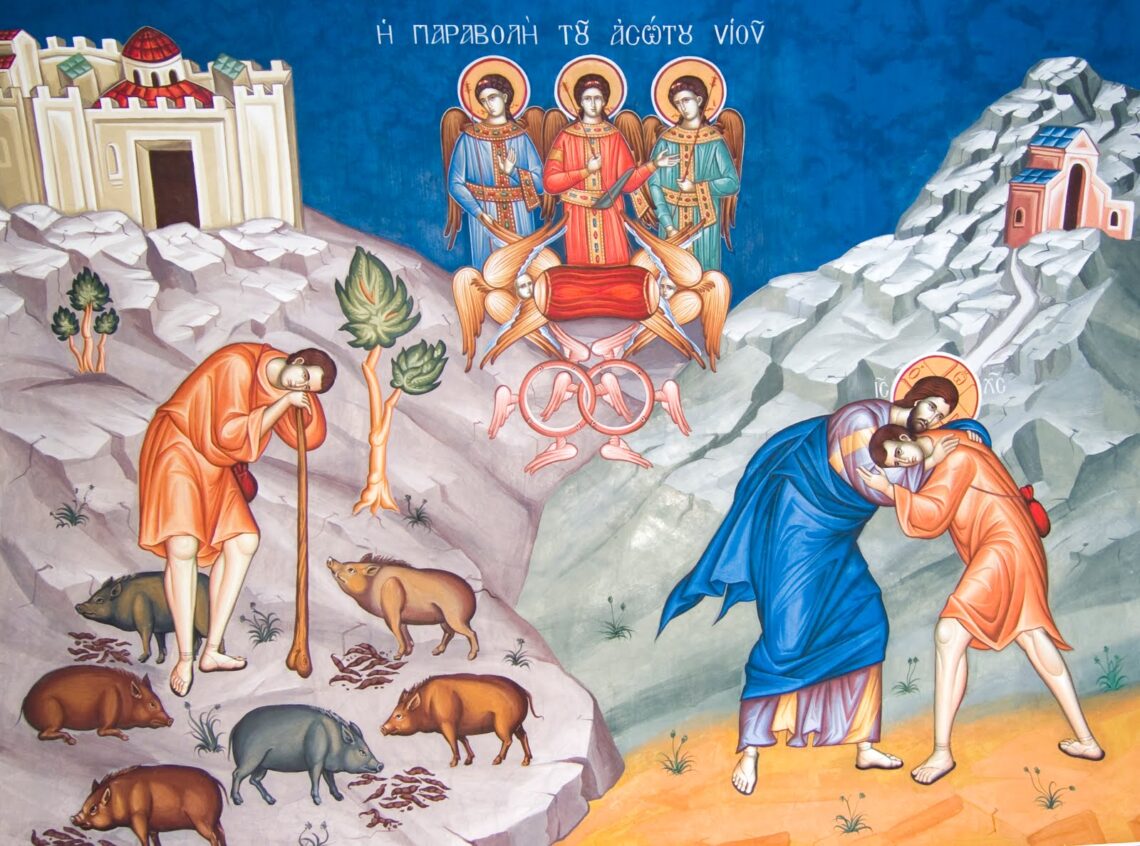
In today’s Gospel, the central figure is a son who asks his father for his share of the inheritance, leaves home without hesitation, wastes everything in reckless living, and ends up utterly destitute—a truly hopeless case.
Driven to such misery that he even considers eating the food given to the pigs, he finally thinks, “If I go back to my father, he will at least let me be one of his hired servants. At the very least, he will give me something to eat.”
But when he returns, while he is still far off in the distance, his father runs to him, embraces him, and cries out, “Oh, my son—thank God, thank God!” He does not even give the boy time to offer an apology. Instead he says:
“Quickly, bring the finest robe and put it on him.
Put sandals on his feet.
Place on him the ring that marks him as my true son.
Go, announce it to the neighbors—we shall hold a feast!
For this son of mine was dead and has come back to life.”
“This is what God is like.”
This is what Christ proclaims in today’s Gospel. God is not one who crushes those who fail to keep the rules, nor one who pronounces death upon those who suffer under the weight of their own weakness and sin.
Rather, Christ declares that God rejoices when we trust in His forgiveness, turn back to Him, and entrust ourselves to His immeasurable and extravagant love. Christ teaches, “If you repent, God will forgive you”—not “Repent, or you will be thrown into hell.”
Meanwhile, the elder brother cannot accept that his father welcomes the younger son with joy and even holds a feast for him.
Through the figure of this elder brother, the Lord warns us that there is nothing more tragic than living curled up in fear of judgment, refusing to trust in God’s bottomless love, and dragging others into that same fear under the name of “God”.
To entrust ourselves to God’s love, to run toward Him in confidence—this is the beginning of our own love for God.
And the One who teaches us this, Jesus Himself, is God who came into the world as a human being and dwells among us. It is exceedingly difficult to love a God who cannot be seen or touched. But can we not love Christ—the Son of God who came to us as a man whom we can see, touch, and hear?
Even now, He continues to call people through His Body, the Church.
Baptism unites those who run toward Him with Christ. The Mystery of Repentance is Christ’s forgiveness for us who, like the prodigal son, have fallen away from the Lord who once welcomed us. When the Gospel is read and preached, Christ Himself speaks to us. And when we receive His holy Body and Blood, His very life is poured into us in the warmth of His forgiveness.
Yes—this Divine Liturgy is the banquet of resurrection.
It is the feast we celebrate with the Lord, we who “were dead and have come back to life, were lost and have been found.”