
Matthew 2:13–23 | January 11, 2026 – Osaka Church
Christ is born!
The birth of Christ took place quietly, hidden from the eyes of most people. Even though the night sky suddenly shone with heavenly light and the angels filled the air with their song, only a handful of people noticed.
But King Herod, fearing that his own power would be threatened by the birth of the true “King of the Jews,” the “Savior,” sensed the event with the sharp instinct of a frightened ruler. He ordered all boys two years old and under in Bethlehem and the surrounding area to be killed. Jesus and His family narrowly escaped and fled to Egypt. After Herod’s death, they returned to Israel and settled in the town of Nazareth in Galilee.
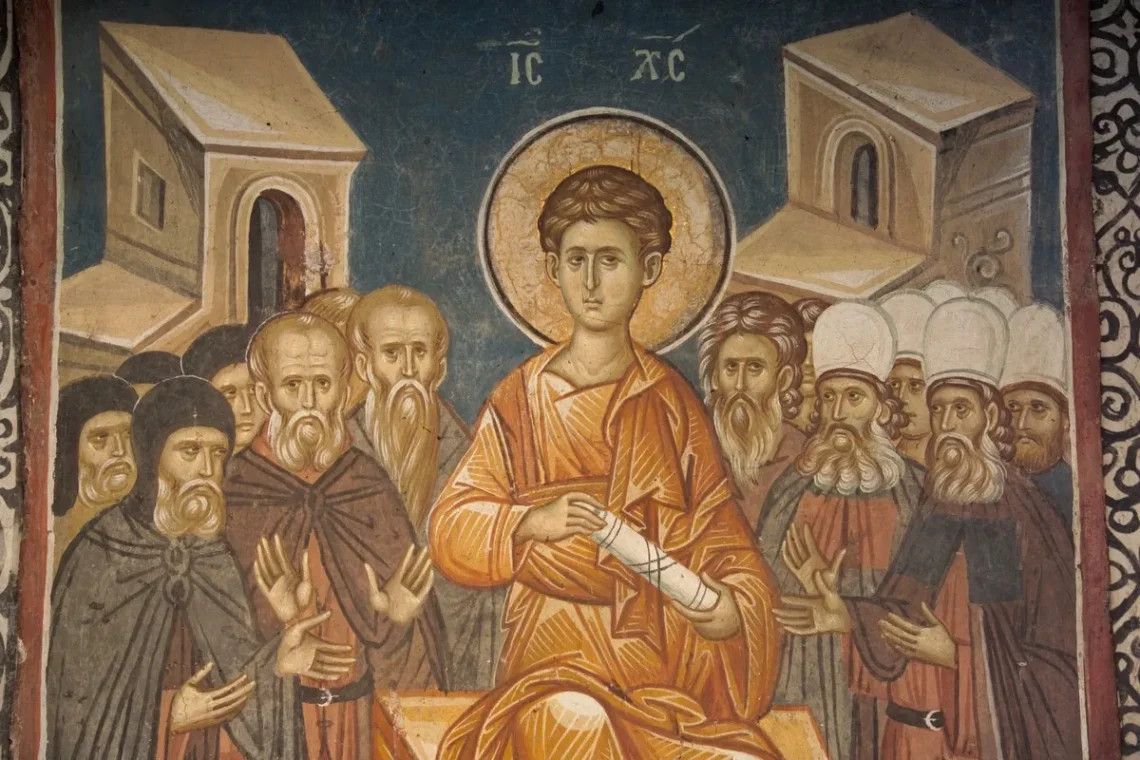
After that, the Gospels tell us nothing about how Jesus grew up. Only one story from when He was twelve years old appears in Luke. Then suddenly, we meet Him again at the age of thirty, standing among the crowds by the Jordan River, waiting for the baptism of John the Forerunner.
Does this “silent” thirty-year period mean that nothing worth mentioning happened?
Let me ask you something.
If someone suddenly asked you, “What is your daily life like?” or “Tell me about your life so far,” how would you answer?
Most of us would probably say, “There’s nothing special to tell.” We rarely experience dramatic or thrilling events. Our lives are not filled with constant excitement. We go to work and do the same familiar tasks. If we are homemakers, we spend our days cooking, cleaning, and doing laundry. Children go to school and fight off sleep through long classes. In short, our days are ordinary.
Jesus’s thirty silent years were likely the same—thirty years of “nothing special.”
Not because something secret was hidden, but because there truly was nothing unusual to report. Yet this does not mean those years had no value.
The very fact that Jesus lived such an ordinary, unrecorded daily life is deeply meaningful.
The fourth‑century Father, St. Gregory of Nazianzus, said:
“What is not assumed is not healed.”
When God became human, humanity began once again to walk the path toward communion with God.
God took on our human body—He shared our flesh.
In doing so, our bodies were restored to what God intended from the beginning: bodies that lift their hands, raise their voices, praise God, and offer love to one another.
Christ endured physical pain on the Cross and died in anguish, loneliness, and sorrow. He shared human suffering, human grief, and human death.
Because of this, our suffering, grief, and death are transformed into something shared with God Himself—a “Passover,” a doorway into life, so that we may share in His Resurrection.
Now you see the point. During those thirty silent years, Christ also shared our ordinary daily life. Daily life is no longer a place where we slowly wither away in monotony. It has been transformed into the place where Christ’s own daily life shines with divine life.
Not only the tense moments of illness or the nearness of death, not only the special missions of monks or clergy—but our everyday routines are filled with God’s life and love and should be marked by gratitude and joy.
That is why, when God became human, He did not choose to be born into a royal family, or a priestly household, or among scholars. He became an ordinary boy in a small town, and later an ordinary carpenter, taking up the ordinary work of His ordinary parents. By doing so, He showed us that our greatest offering to God is found not in extraordinary deeds, but in faithfully and patiently carrying out the simple tasks given to us each day.
After His Resurrection, the Lord told His disciples,
“Go to Galilee; there you will see Me.”
In the ordinary daily life He lived in Nazareth, and in the ordinary daily life we live today—in our own Galilee—we find the key to understanding how Christ comes to meet us.